
The Benefits Cliff: What You Really Lose Going Independent
When you leave corporate to go independent, everyone talks about the salary gap. Nobody talks about the $20,000-$30,000 in benefits you just lost. Here's what disappeared — and how to replace it.
The Benefits Cliff: What You Really Lose Going Independent
When you leave corporate to go independent, everyone talks about the salary gap. Nobody talks about the $20,000–$30,000 in benefits you just lost. Here's what disappeared — and how to replace it before it costs you.
The Benefits Gap Is Invisible — Until Something Goes Wrong
When you walked out the door of your W-2 job, two gaps opened. One of them is loud and obvious: the salary gap. You know exactly what you gave up, and you've probably already calculated how to replace it with client revenue.
The second gap is quiet. It's the benefits cliff — and most independent professionals don't see it until they're already falling.
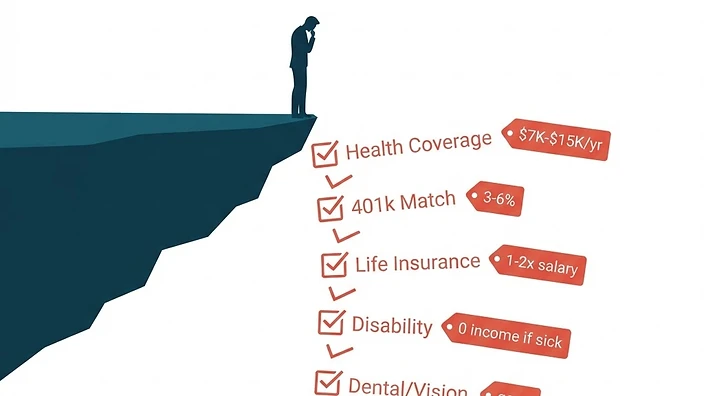
Here's what disappeared the day you went independent:
- Health coverage: $7,000–$15,000/year (employer paid most or all of your premium)
- 401(k) match: typically 3%–6% of salary, often $5,000–$10,000/year
- Life insurance: group term coverage worth $500–$1,500/year on the private market
- Disability insurance: long-term disability coverage that would have replaced 60% of your income — worth $1,500–$3,000/year
- FSA/HSA contributions: tax-advantaged accounts your employer administered
- Dental and vision: $300–$800/year combined
Add it up: $20,000–$30,000 per year in benefits you no longer have.
The salary gap is predictable. You can budget for it. The benefits gap is invisible until something goes wrong — a surgery, a disability, a year where the market drops and your unmatched retirement account can't recover.
The Replacement Priority Order
You can't replace everything at once, and you shouldn't try. Here's the order that protects you fastest:
- Health coverage — One illness without insurance can wipe out a year of revenue. This is non-negotiable.
- HSA — If you qualify, fund it. It's the only triple-tax-advantaged account in America (more on this in a future post).
- Disability insurance — Your ability to earn is your most valuable asset. Protect it before anything else.
- Life insurance — Especially if anyone depends on your income.
- Retirement — Replace the match you lost and automate contributions.
- Dental and vision — Lower risk, but worth a low-cost plan once the first five are covered.
The Real Runway Number
Most independent professionals calculate their emergency cushion as 6 months of expenses. That math usually ignores the benefits cliff.
Here's the truth: replacing your lost benefits costs $1,500–$2,000 per month — health coverage, disability premiums, retirement contributions, and the rest. If your monthly burn is $5,000 and you set aside 6 months ($30,000), your real cushion needs to be $39,000–$42,000 to absorb the benefits you're now paying for out of pocket.
The cushion that felt safe at W-2 is thinner than you think at 1099. Recalculate it with the benefits cliff included.
What to Do This Month
- Get health coverage in place — even a basic plan beats self-insuring a worst-case scenario.
- Open and fund an HSA if your plan qualifies.
- Price a private long-term disability policy.
- Recalculate your runway number with $1,500–$2,000/month of benefit replacement added.
The salary gap is your growth problem. The benefits gap is your survival problem. Solve the survival problem first.
Ready to close the benefits gap the right way? Start at coveredbykeith.com for a personalized health coverage strategy built for independent professionals.
Ready to explore your options?
Book a complimentary strategy call to discuss your health coverage needs.
Book a Complimentary Strategy CallNo obligation. This first conversation is simply a chance to understand your situation and determine whether it makes sense to explore further.
You'll be taken to our secure scheduling/contact page.