
The 90-Day Transition Plan: Going from Corporate to Independent
Planning to leave corporate for independent work? Here's the 90-day plan I walk clients through — protect first, structure second, optimize last.
The 90-Day Transition Plan: Going from Corporate to Independent
Planning to leave corporate for independent work? Here's the 90-day plan I walk clients through — protect first, structure second, optimize last. Most people do it backwards, and it costs them.
The Right Order
Most independent professionals handle the transition in exactly the wrong order: they optimize first ("how do I save on taxes?"), structure second ("should I be an S-corp?"), and protect last ("oh no, I have no health insurance"). By the time they get to protection, they've already been uninsured for weeks.
The right order is the reverse.
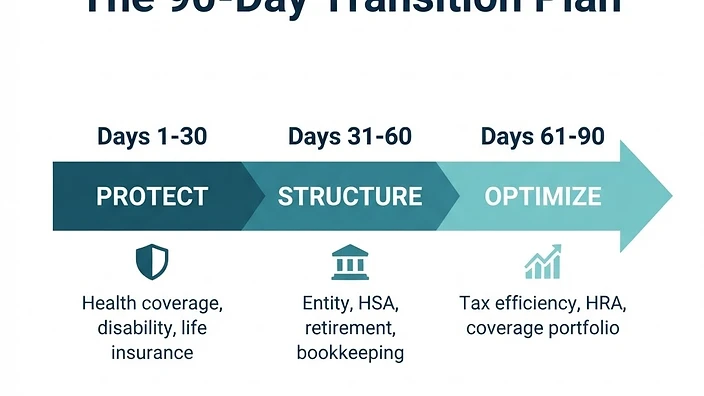
- Days 1–30: PROTECT — replace the benefits you're about to lose.
- Days 31–60: STRUCTURE — set up the entity and accounts that make everything else work.
- Days 61–90: OPTIMIZE — stack the tax advantages once the foundation is solid.
Days 1–30: PROTECT
The goal of the first month is to make sure nothing catastrophic can wipe you out while you're getting started.
- Secure health coverage BEFORE your last day. COBRA is a bridge, not a plan — it's expensive and temporary. Start shopping a real plan 30–45 days before your last day so coverage begins the day your corporate plan ends. A gap of even a few weeks can become a gap-year if something happens.
- Get disability coverage. Private long-term disability for a healthy professional typically runs $40–$80/month. It replaces 50–60% of your income if you can't work. Your ability to earn is your most valuable asset — protect it before your laptop.
- Get term life insurance. If anyone depends on your income, a 20-year term policy is cheap at most ages and replaces the group life coverage you're losing.
If you do nothing else in month one, do these three. Everything else can wait; a uninsured medical event can't.
Days 31–60: STRUCTURE
Once the catastrophic risks are covered, set up the structure that makes the business — and the tax savings — actually work.
- Choose your entity. Sole proprietor vs LLC vs S-corp. The general threshold I use: once you're above ~$80,000–$100,000 in net profit, the S-corp election usually pays for itself in self-employment tax savings. Below that, a sole proprietorship or single-member LLC is often fine.
- Open an HSA. If your health plan is HSA-eligible, open the account and fund it. 2026 limits: $4,400 individual / $8,350 family. It's the only triple-tax-advantaged account in America — don't leave it empty.
- Set up a Solo 401(k) or SEP-IRA. Replace the 401(k) match you lost and get a retirement vehicle built for self-employed income. A Solo 401(k) often allows both employee and employer contributions, maximizing the deduction.
- Get bookkeeping in place. Separate business accounts, a real bookkeeping tool, and a monthly close habit. You can't optimize what you can't measure.
This is the month that turns a freelance gig into a business.
Days 61–90: OPTIMIZE
Now that you're protected and structured, optimize. This is where the real money is — but it only works because the first 60 days built the foundation.
- Review plan structure for tax efficiency. Confirm your premiums are landing in the right place for the self-employed health insurance deduction (S-corp owners: check W-2 Box 14 reporting).
- Stack tax advantages. Premium deduction + HSA contribution + retirement contribution can combine to reduce your taxable income by tens of thousands of dollars. Stack them, don't pick one.
- Evaluate an HRA. For S-corps, a Health Reimbursement Arrangement can reimburse out-of-pocket medical costs with pre-tax dollars — on top of the premium deduction.
- Build the coverage portfolio. With health, disability, and life in place, fill the remaining gaps: dental/vision, and review the whole portfolio annually.
The Cushion You Actually Need
While you're running this plan, recalculate your runway. Replacing the benefits you lost costs $1,500–$2,000/month — health coverage, disability premiums, retirement contributions, the rest.
If your monthly burn is $5,000 and you set aside 6 months ($30,000), your real cushion needs to be $39,000–$42,000 to absorb the benefits you're now paying for out of pocket. The cushion that felt safe at W-2 is thinner than you think at 1099.
Do It in the Right Order
Protect first. Structure second. Optimize last. Do it backwards and you'll save on taxes for a few months, then get blindsided by a medical bill or a gap in coverage that wipes out the savings.
Planning your transition? Start at coveredbykeith.com — we'll build your 90-day plan around your real coverage, structure, and tax situation.
Ready to explore your options?
Book a complimentary strategy call to discuss your health coverage needs.
Book a Complimentary Strategy CallNo obligation. This first conversation is simply a chance to understand your situation and determine whether it makes sense to explore further.
You'll be taken to our secure scheduling/contact page.